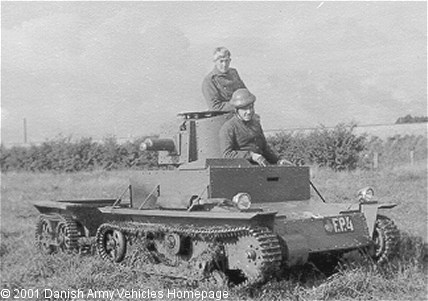
Danish Army
Specific: Borrowed August 1932
for evaluation from Great Britain. In the 6 weeks of
evaluation it didn't perform well. Impossible to steer
on-road, and the tracks tended to fall off. The best
score in the evaluation was the price !
Despite the bad impression 2 unarmed Patrol
Cars (72 kb)
were purchased in August 1933 and retro-fitted with a
Danish Madsen machine gun.
Historical: The Carden-Loyd patrol car was
developed from a private venture by Major Gifford Le Q.
Martel in Camberley. He
built a one-man tank (AKA "Tankette") in his garage from various parts and
presented it to
the War Office in 1925. The idea seemed promising so the War Office
contracted Morris Commercial Motors to build four trankettes.
With the polarization of the idea, other companies produced their own
interpretations of the idea. One of these was Carden-Loyd Tractors Ltd,
of Sir John Carden and Vivian Loyd. Besides one-man vehicles they also
proposed two-man vehicles in 1926 which turned out to be a more effective and
popular idea. Vickers-Armstrongs manufactured and marketed it worldwide.
Considered a reconnaissance vehicle and a mobile machine gun position,
the Mark VI was the final stage of development of Carden Loyd series of
tankettes.
Mass production took place from 1928 and by 1930 some 270
units had been delivered to the British Army.
For its day the Mk VI was cheap to produce, easy to maintain and was
fast and versatile. It functioned not only as a machine gun carrier, but
as a scout, light gun vehicle, smoke screen launcher and mortar carrier.
The vehicle could pull a trailer for carrying ammunition.
The patrol car influenced design on later vehicles like
CV33 from Italy, TK-S from Poland, T27 from Russia, T-33
from Czechoslovakia and the Renault UE from France.
The patrol car was exported to Canada, Czechoslovakia,
France, India, Italy, Japan, Poland, and Russia.
Length: 2.59 m (101 inches).
Width: 1.75 m (68 inches).
Height: 1.65 m (64 inches).
Weight: 2.000 kg (4.400 lb.).
Armour: 11 mm (0.4 inches) max.
Engine: 6-cylinder Meadows.
Horsepower: 40.
Transmission: N/A.
Transfer case: N/A.
Electrical system: N/A.
Brakes: N/A.
Tyres: None.
Fording depth:
without preparation: N/A.
with deep water fording kit: N/A.
Fuel type: Petrol.
Fuel capacity: N/A.
Range: 150 km (93 miles).
Crew: 2.
Armament: 1 Lewis machine gun.
Additional: N/A.
|