Danish Army
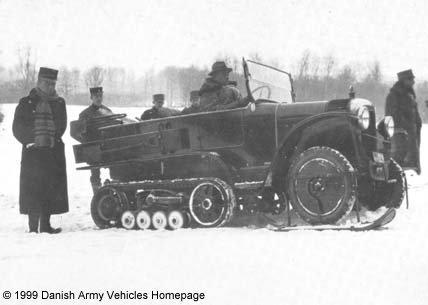
Specific: The Citroën K1 which was based on
the Citroën type B2, was
bought in 1923 for evaluation purposes and was licensed
"HtK 129". Acquisition price was around
12.000,- Danish kroner. The performance of the Citroën
was tested in summer 1923 and winter 1923/24 (note ski on
front-wheels). The tests went well and in 1924 further 2
Citroëns P7T (licensed HtK 75 & HtK 244) were bought.
The vehicles went through extensive testing and after
some years they were all worn out.
Note the extra cooling air louvres in the hood.
In 1932 a new 18 hp Citroën P17 (35 kb) was delivered and
the 3 worn out 10 hp Kegresses went back to Citroën as
part of the payment.
One of the tasks foreseen for the Kegresse-vehicles was
to perform reconnaissance for artillery-units.
Historical: The Kegresse-drive, which
was mounted with a endless rubber band was invented in
1910 - 11 by Adolph Kégresse, a Frenchman who had worked
as technical manager for the Russian Czar Nicholas II
from 1906 to 1917. Mr. Kegresse converted the Packard and
Rolls-Royce cars of Czar Nicolas, as well as some
Austin-Putilov armoured cars.
A lot of Packard trucks were converted with the
Kegresse-drive in 1915, and used as ambulances.
Other companies like Caterpillar and Holt in the United States had toyed
with the idea of a halftrack, but Adolph Kégresses solution with a
rubber band gave a more comfortable ride, and didn't tear up the road
surface.
After the revolution he returned to France via Finland
and, in conjunction with Mr. Jacques Hinstin, produced a
boogie which was adopted by André Citroën in 1920.
In 1922, five Citroën-Kegresse K1 vehicles successfully
completed the Trans-Sahara Expedition crossing the desert
to Timbuktu. Two years later, Georges-Marie Haardt and
Louis Audion-Dubreuill used Citroën-Kegresse vehicles to
traverse Africa in an eight-month journey that proved the
concept.
The Citroën Kegresse was manufactured at Courbevoie and
later at Citroëns Lavalllois factory in the northern
suburbs of Paris.
Kegresse-equipped vehicles were used by the French Army as field car,
armoured car, tractor, anti aircraft gun mount, cavalry vehicle and
telephone engineers´ vehicle up to the outbreak of WW II.
Other known users were Belgium, Chile, Germany, Great
Britain, Italy, Japan, the Netherlands, Poland, Spain and
the United States.
Some of the above mentioned countries only tested the
Kegresse-drive, some acquired a licence to produce it,
and some bought complete vehicles to their armed forces.
Length: N/A.
Width: N/A.
Height: N/A.
Weight: N/A.
Engine: Own 4-cylinder, 1.500 cm3 (91 cubic inches)
displacement.
Horsepower: 10.
Transmission: N/A.
Transfer case: N/A.
Electrical system: N/A.
Brakes: N/A.
Tyres: N/A.
Fuel type: Petrol.
Fuel capacity: N/A.
Range: N/A.
Crew: N/A.
Additional: The shown vehicle was bases on the Type B2.
Produced from 1921 to 1924 it was the first Citroën Kegresse commercial
available. Driving sprockets were on
fixed rear axle; forward end of boogie could move up and
down.
A picture of a Citroën Kegresse with the revised rear boogie (P7)
has appeared. The history of this vehicle and is not
known.
|