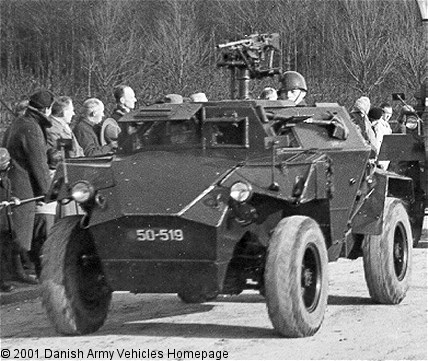
Danish Army
Specific: Delivered by the
British forces in Germany in 1945. Superseded
from 1953 by the Jeep (Willys MB/ Ford GPW). When the last units left
the inventory in 1960 a total of 99 units had been delivered.
Historical: Prototyped by the Rootes Group in
1942 with quantity production taking place form early
1943 by Karrier Motors at Luton in Bedfordshire. The
Humber was developed in direct response to a lack of
sufficient production capacity for the Daimler Dingo. The
vehicles utilised many of the automotive components of
the Humber armoured car.
The floor was not armoured on Mk I and early Mk II
vehicles and the armoured roof was provided with a
pair of sliding hatches that allowed the operation of a
pintle- mounted Bren gun. Early vehicles had rearward
observation shutters but these were subsequently deleted.
Mk II vehicles had different gearbox and a little bulge
in the hull above the steering wheel.
A total of 4.298 vehicles were produced until 1945, 1.698
of them being the Mk I model which were produced from
1944.
Length: 3.83 m (151 inches).
Width: 1.87 m (74 inches).
Height: 2.13 m (84 inches).
Weight: 3.417 kg (7.595 lb.).
Armour: 14 mm max.
Engine: Own 6-cylinder, 4.088 cm3 (249 cubic inches)
displacement, carburettor, liquid-cooled.
Horsepower: 87 at 3.300 rpm.
Transmission: 4-speed gearbox.
Transfer case: 2 speed with front axle declutch
(in "high" only).
Electrical system: 12 volt, negative ground.
Brakes: Hydraulic.
Tyres: 9.25 - 16.
Fording depth:
without preparation: 0.91 m (36 inches).
with deep water fording kit: N/A.
Fuel type: Petrol.
Fuel capacity: 88 liter (19.5 gallons).
Range: 320 km (200 miles).
Crew: 2 - 3.
Armament: Remote controlled 7.7 mm
(.303) Bren machine-gun.
Additional: The tyres were
"run-flats", giving a range of 50 miles on a
punctured tyre. Mounted with a No. 19 radio set. Top
speed were approx. 100 km/h. Other known users besides
Britain and Denmark were Belgium, Canada, France, Italy,
the Netherlands and Norway.
|